Peace Iftar for Syrian refugees
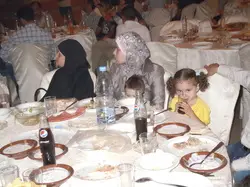
Report on our first Peace Iftar uniting Sunnis, Alawis and Christians in solidarity with Syrian refugees in the Akkar (Lebanon), written by R&R member Isabella Eisenberg.
On Monday, 29 July 2013 (20 Ramadan 1434), an unlikely group of fellow diners gathered in front of a beautiful mountain top restaurant in the village of Miniara, in the Akkar district of North Lebanon, less than 15 minutes by car from the Syrian border. R&R Syria united representatives from all religious communities and groups present in Akkar for a Peace Iftar in favour of Syrian refugees from Qusayr, Homs and other parts of the country. Amongst those attending were representatives of Sunni and Alawi groups who are fighting each other a few kilometers further South (in Tripoli) and a few kilometers further North (in Syria). A potentially explosive mixture, and yet – if managed well – a mixture with huge potential.

Guests of honour included the Sunni Mufti of Akkar, Sheikh Ziad Zakarijah, the Greek-Orthodox Metropolitan of Akkar and Wadi Nasara (Syria) Mgr Basilius Mansour, the Alawi representative for the Akkar district, Sheikh Ali Qaddour and a representative of the Maronite Archbishop of Tripoli, Mgr Elias Geryes. The Archbishop himself regretted not being able to join as he was still in Brazil for the World Youth Day. Also present were 21 mayors from neighbouring towns and villages, a range of other sheikhs, imams, ulama, and priests, as well as representatives of the UN and civil society organisations both from Syria and Lebanon.
And then the refugees, more than 100 of them, both sexes, all ages, all backgrounds: Moqtada, the math teacher who had his left leg shot to pieces three months ago; Hisam, the electrician with the sparkling eyes and firm handshake; Walid, 26 years old and dream of every girl and every basketball team - if only he were not walking on crutches; Abdul-Karim, whose wife died on the 8-day march into Lebanon and who is now a single dad with 5 toddlers; Sana, the mother of the adorable 4-year old pig-tailed Sheher; Hiba, a bubbly 10-year old schoolgirl, and so on and so forth.
And, given the audience, the dignitaries (and the Mufti was the first to speak and set the tone) were compelled to squarely address the ‘’elephant in the room’’, and acknowledged what is happening in Syria, and what has happened to the Syrian refugees present in the room, expressed his solidarity with them, and all other dignitaries followed course, including the Alawi Sheikh.

Putting refugees together in one room with members of the Alawi community, associated with those whom they had had to run from, had been no easy undertaking and required a lot of preliminary negotiations. And when, at the event, the Alawi Sheikh stood up to address the room, a member of his security team stood behind him, and tensions in the room were palpable. And yet, the Sheikh’s message of peace hit the refugees as sincere, and they applauded him, which seemed a bit like a miracle in itself. He received contradiction though when he turned more political and the whole exercise was put in jeopardy. But the Sheikh reacted correctly and successfully claimed for himself the right to have his own political opinion.
In Lebanon, religious dignitaries are used to giving speeches on the inter-relatedness of the three Abrahamic religions, interfaith cooperation, solidarity and peace and love for everyone. But this was different. This was not just about theory and ideals; this was about putting all this into practise in the face of a horrendous war raging just a few kilometres away. The refugees seemed thirsty for the truth to be spoken, for the wider public and the dignitaries of the region to acknowledge their situation, and to take them seriously.

R&R’s Peace Iftar for local Lebanese and Syrian refugees is a unique initiative. Whilst numerous interfaith gatherings have been undertaken in Lebanon in the past, none have included and focused on solidarity with Syrian refugees. The refugee question in Lebanon is taboo as the wounds of the Lebanese Civil War and the Syrian implication in it are still open. Lebanon has done its best to accommodate situations like some Lebanese schools counting more refugee than local children this year, but hospitality and tolerance have reached its limits. Combining interfaith with refugee issues most other organisations have therefore considered as just too explosive.
R&R’s next peacebuilding interfaith events will take place for the Eid al-Fitr next week, bringing together refugees and local host communities for a big childrens’ festival, and on the occasion of the feast of the Assumption of the Virgin Mary on 15 August with a joint march to a local feast, this time in a Christian village of the Akkar district, close to the first Peace Centre.
Please find more photos and individual descriptions on our Facebook page: www.facebook.com/relief4syria